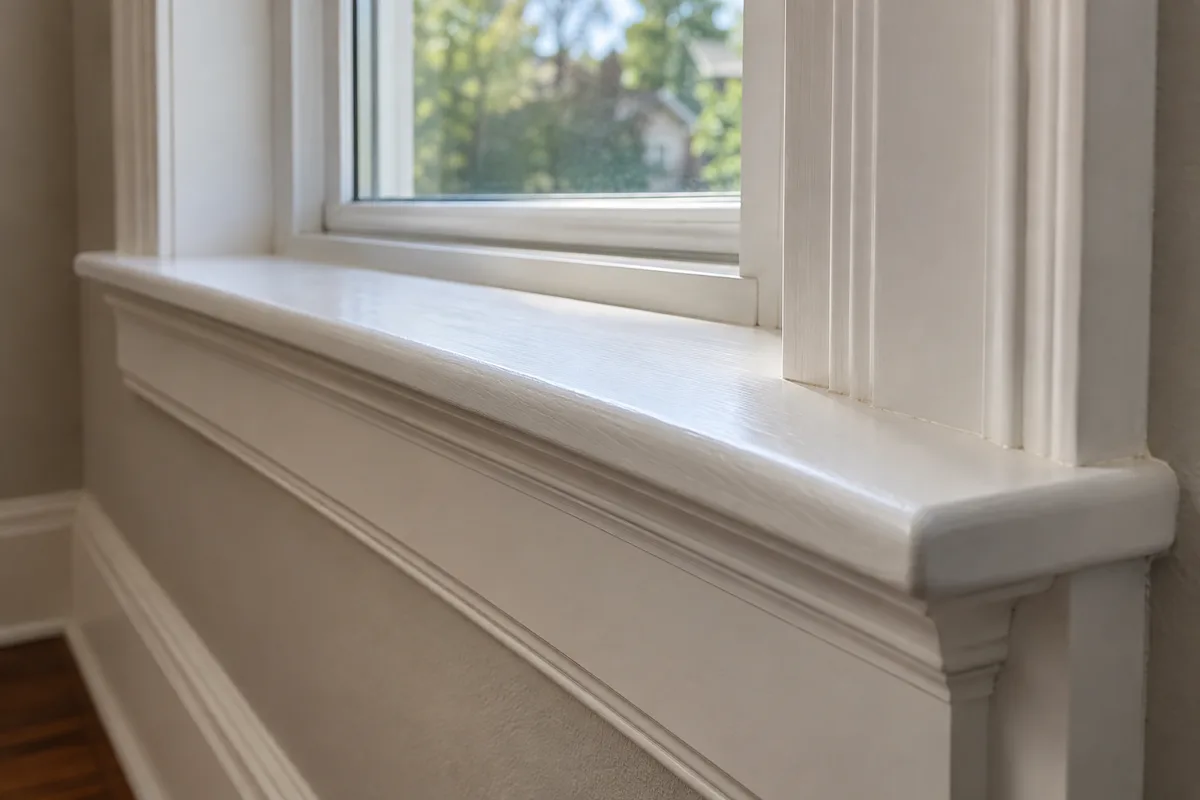
The projection of a window stool is measured outward from the finished wall, but the eye judges it against the apron and casing below and beside it. A dimension that works on one wall can look oversized on another because the surrounding trim has changed. Start with those relationships rather than a universal number.
Make a section sketch through the bottom of the window. Mark the window frame, finished wall face, apron face, and proposed front edge of the stool. This makes it clear which measurement refers to the total board depth and which refers only to the visible overhang. Confusing those two dimensions is an easy ordering mistake.
For an illustrative comparison, suppose an apron stands three-quarters of an inch proud of the wall. A stool projecting only slightly beyond that face will read as a compact cap. Extending it much farther creates a more shelf-like ledge. Those are design alternatives, not recommended dimensions for every window. The actual window assembly and material determine what can be built.
Think in two directions
The stool also extends sideways beyond the opening. Its small ears should relate to the outside edges of the side casings. A generous front projection with almost no side extension can look abruptly cut off. Conversely, long ears on a shallow stool may appear oddly stretched.
Cut a cardboard outline and hold it at the proposed position. Cardboard cannot represent the material's strength or fixing, but it is useful for testing the boundary in the room. Walk past it, pull the curtains, and move the nearest chair. The ledge should not become an unexpected obstacle.
A window over a desk deserves particular care. A projecting stool can prevent the desk from moving back or interfere with a monitor arm. Over a bed, it may be partly concealed by the headboard. Behind full-length curtains, a large projection can push fabric away from the wall and change the way it hangs.
The shape of the front edge affects the impression too. A softly rounded edge may feel less abrupt than a square slab of identical depth. A thick decorative nose adds visual weight even if its outer boundary has not moved. Compare finished samples, not merely bare boards.
Keep the use realistic
A narrow decorative stool is not automatically a shelf capable of supporting heavy objects. If the plan includes substantial plants or other loads, have the support and material designed for that purpose. Also consider water exposure rather than assuming a painted surface tolerates repeated wet pots.
Where condensation or staining is present, address the cause before covering it with a deeper ledge. Increasing projection does not repair the window or improve its moisture behavior.
Finish by recording three separate dimensions: the total stool depth, its projection beyond the finished wall, and the side extension beyond the casing. A small end-view drawing beside those numbers communicates the intended result far more reliably than “a slightly deeper sill.”