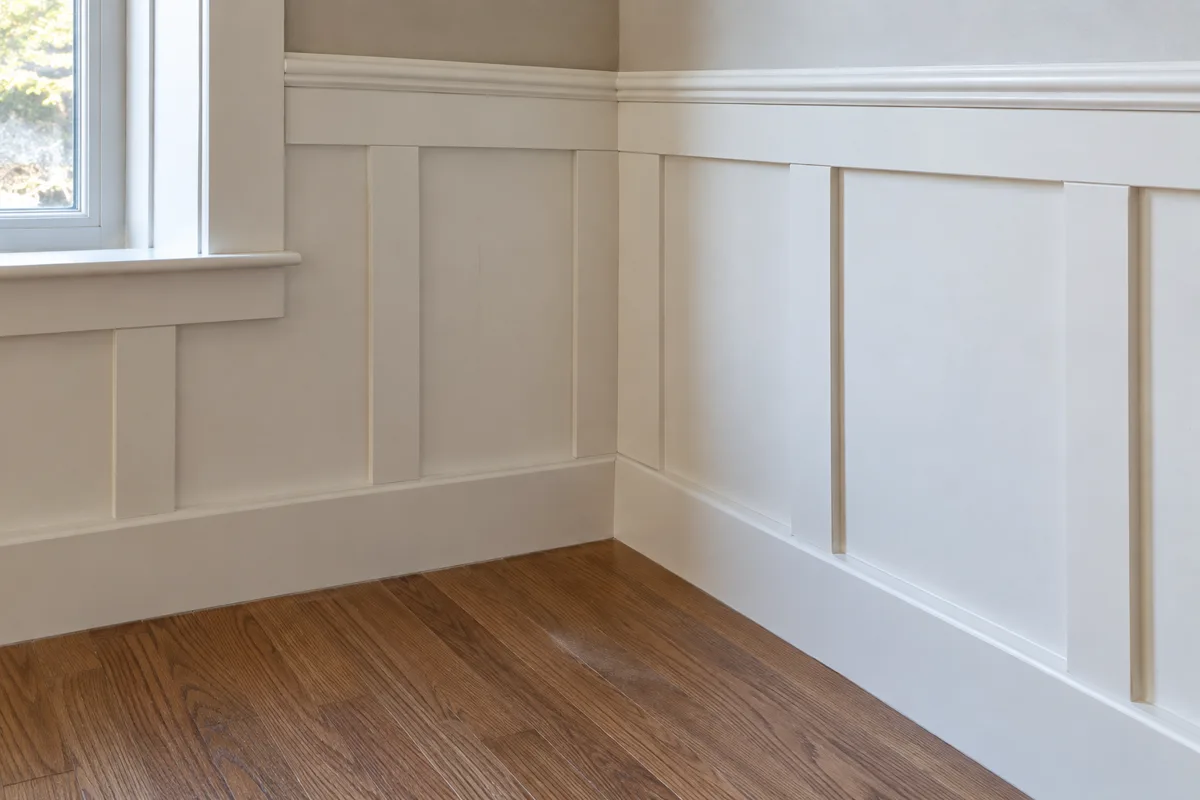
An inside corner compresses two wall layouts into one view. Frames that look generous on separate drawings can appear crowded when their profiles approach each other at the corner. The corner margin needs to be judged as a three-dimensional space.
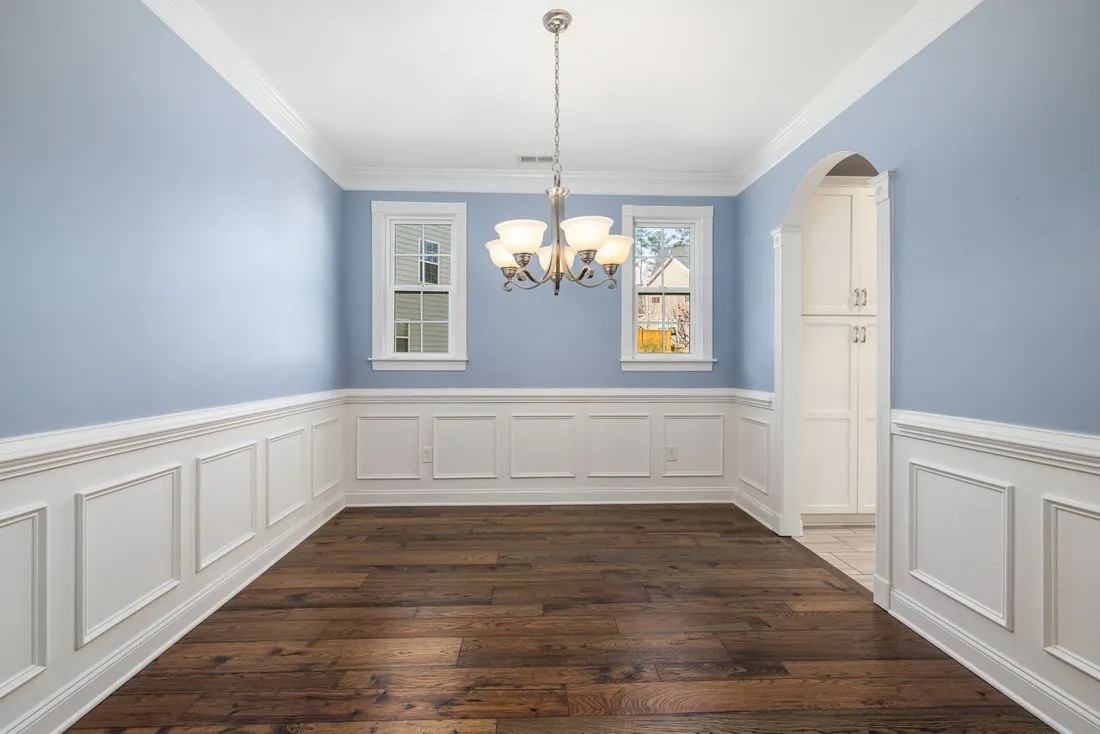
For applied rectangular molding, a clear blank margin on each wall is often effective. The two frames remain distinct, and their shadows do not collide. That does not require identical panel widths on both walls; shared heights and related margins can provide enough continuity.
Board-and-batten and plank patterns pose a different question. Does a vertical strip occupy the corner, or does each wall end with its own field? A narrow leftover sliver can be distracting. Draw the last bay on one wall beside the first bay on the next rather than calculating the walls independently.
Select a starting reference
If one wall contains the main feature—such as a bed or a centered window—it may deserve the primary alignment. The adjoining wall can adapt at the corner. Trying to center every wall independently while demanding perfect corner continuity can produce conflicting goals.
A full-room elevation strip is useful: draw the walls side by side in the order you encounter them, with corners clearly marked. This exposes patterns that almost align but drift from wall to wall.
The physical corner may not be square or straight. A level horizontal rail can be carried around the room while the floor below varies. Vertical trim still needs fitting to the actual wall, not forced into a geometric assumption from the drawing.
Do not fill an awkward layout with a large decorative corner block unless that block belongs to the overall design. It may solve the meeting while introducing a stronger feature than the rest of the paneling.
Mock up the two adjacent areas together. A single sample on one wall cannot show how the shadows interact. Check from across the room, where the corner usually appears darker.
Once the corner logic is clear, use it consistently at similar conditions. Some corners may need individual fitting, but the design intent should not change unpredictably. The aim is a pattern that turns with the room without making every corner look like a separate repair.