“Removable” can mean several different things. A panel may be possible to unscrew, possible to detach with repairs afterward, or designed to leave a surface largely unchanged. Those are not equivalent promises, especially in a rental or on a delicate wall finish.
Start by defining the acceptable result. Is repainting allowed? Are small fixing holes acceptable? Must the original wallpaper remain untouched? Does the landlord require written approval? The answer determines which systems are worth considering.
Adhesive strips and peel-and-stick products should not be assumed harmless on every surface. Their performance depends on the product, paint condition, curing, texture, and removal method. Follow the specific instructions and test only where appropriate and permitted. A successful small test does not guarantee that an entire wall will release identically months later.
Consider an independent element
A freestanding screen, framed panel, or furniture-backed feature may provide some of the visual effect without applying trim directly to the wall. It still needs to be stable and suitable for the room. Tall or heavy pieces may require anchoring, so “freestanding” is not automatically a no-fixing solution.
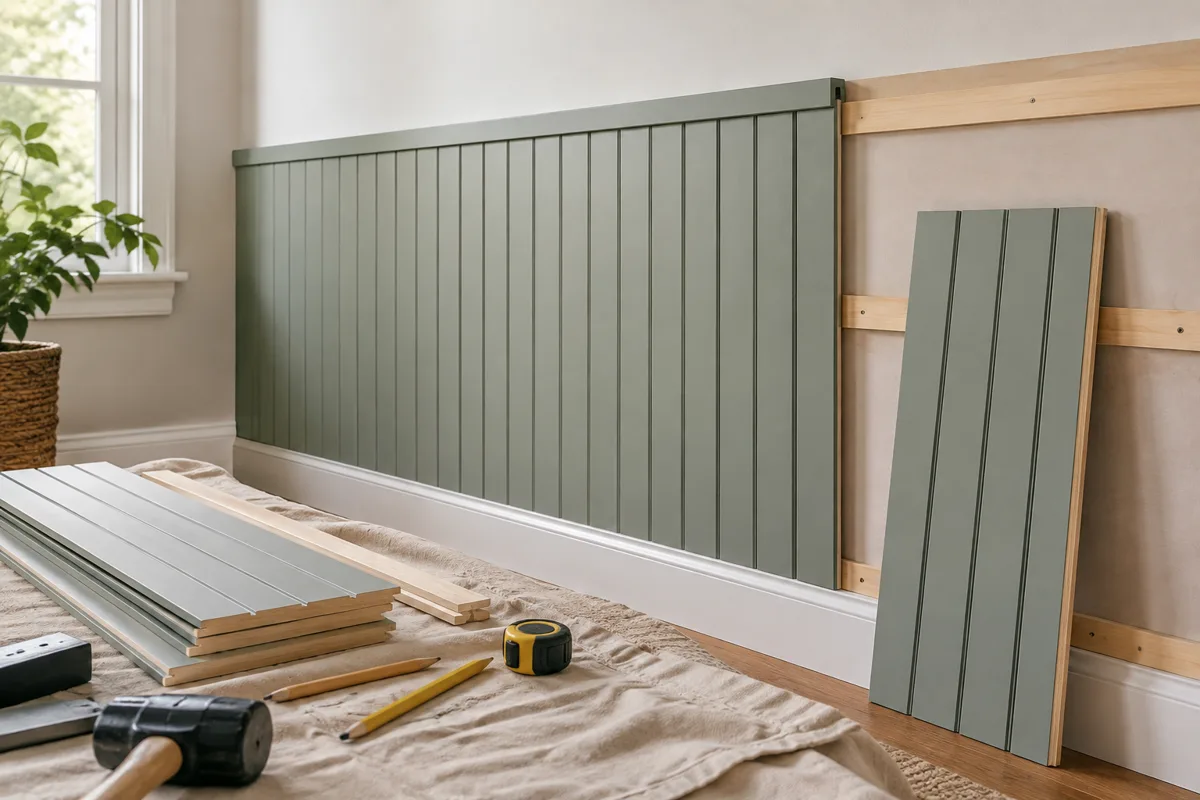
A panel attached with accessible mechanical fixings can be easier to understand than one bonded across its full surface. However, the support, load, and wall suitability need to be properly designed. Decorative appearance does not establish structural stability.
Draw the removal sequence before the installation sequence. Identify which edge comes off first, how fixings remain accessible, and where a person can support the piece during removal. If the plan requires destroying the cap to reach hidden screws, the system is only partly reusable.
Preserve the original condition
Photograph the wall before work begins and keep any written permission with the product details. Store original trim or hardware if it is removed legitimately, labeling its location rather than placing everything in one unmarked box.
Avoid claiming a treatment is damage-free in a project plan unless the exact conditions support that statement. It is more useful to state the expected repair work and the known limitations.
For a short tenancy, a convincing painted furniture arrangement or large framed textile may provide a better return on effort than a complicated supposedly temporary wall assembly. The right solution is the one whose installation and removal both fit the situation, not the one with the most reassuring label.