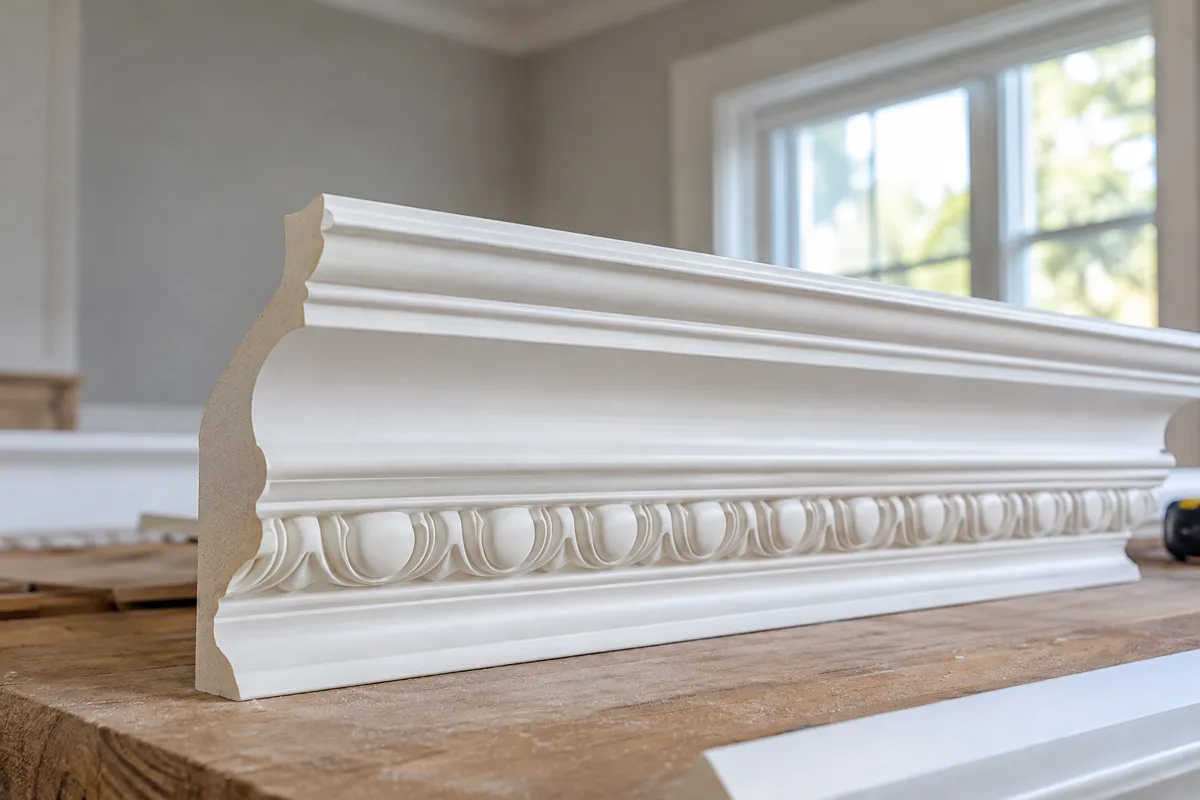
An elaborate molding does not always need to be carved from wood or assembled from several pieces. Rigid polyurethane products can provide decorative profiles in a lightweight form. This can be useful where the shape matters more than visible wood grain, especially for a painted treatment.
Lightweight does not mean that a piece can be attached casually. The manufacturer still specifies how it must be supported, joined, fastened and finished. Decorative molding is not a support for shelving, electrical fixtures or other loads.
Inspect what paint will reveal
Look across the face under angled light. Check the crispness of small details and the condition of thin projecting edges. Shipping damage can be hard to spot when several pieces are nested together. A crushed tip or irregular seam may remain visible after painting, particularly with a reflective finish.
Examine the back as well. Its shape determines how the molding contacts the wall and where the specified adhesive belongs. A hollow-looking area or recess may be part of the design; do not assume every void should be packed with an improvised material.
Ask for a short sample or inspect an actual piece rather than judging solely from a catalog rendering. Hold it at the planned height. A deep ornate pattern can cast much stronger shadows than its front-facing photograph suggests.
Make the joins part of the decision
Some decorative profiles repeat a motif. A join placed without regard to that repeat can interrupt the pattern. Measure the room and discuss layout before ordering, allowing for the material needed to align visible details.
Rigid polyurethane and flexible molding should not be treated as the same product. A rigid piece is not intended to be forced around a curve simply because both materials are sometimes described as synthetic. Curved applications need a product and geometry approved for that purpose.
Check the finish sequence in the instructions. Some rigid products allow painting before installation and touching up afterward; others have different requirements. A factory primer is not necessarily a complete final coating. Use compatible fillers, adhesives and paint rather than assuming that a product intended for bare wood will behave identically.
Keep the design proportional to the surrounding openings and furniture. The ability to install a large profile does not mean the room needs one. A full-size corner mockup can answer that question cheaply, while also exposing any difficult junction with an existing casing, ceiling or return.