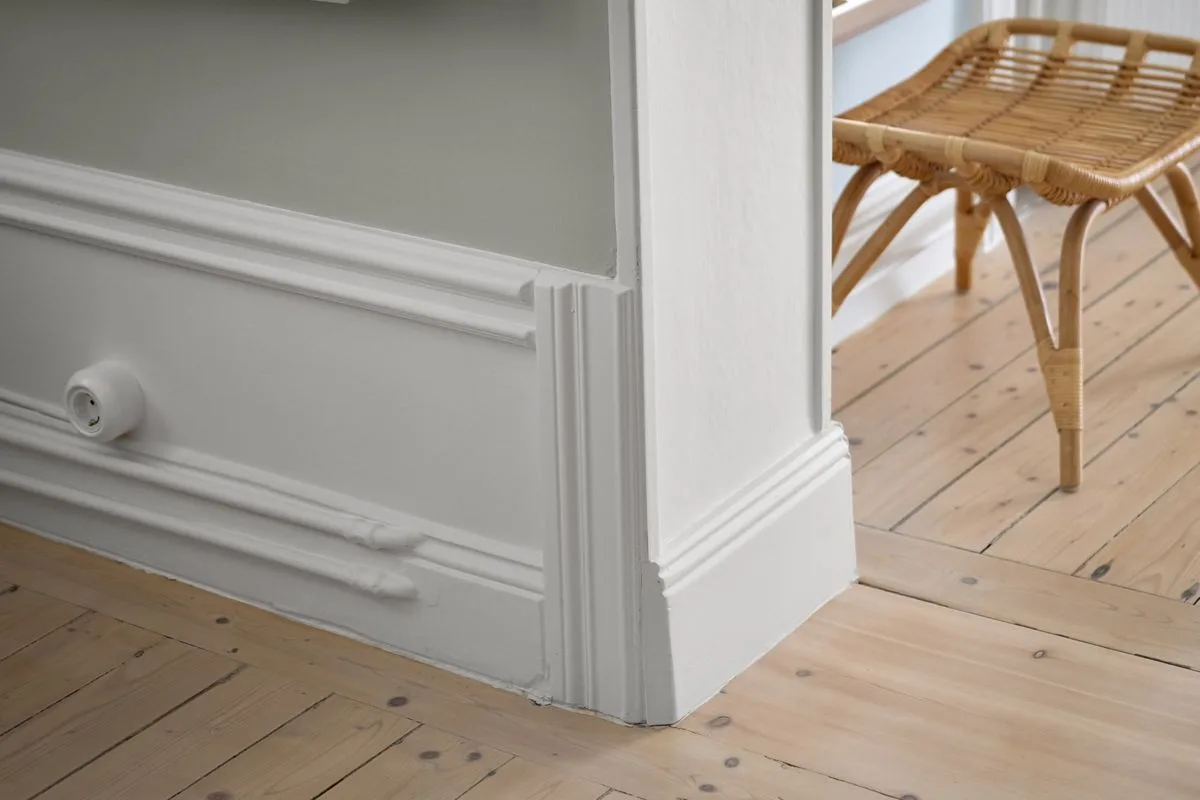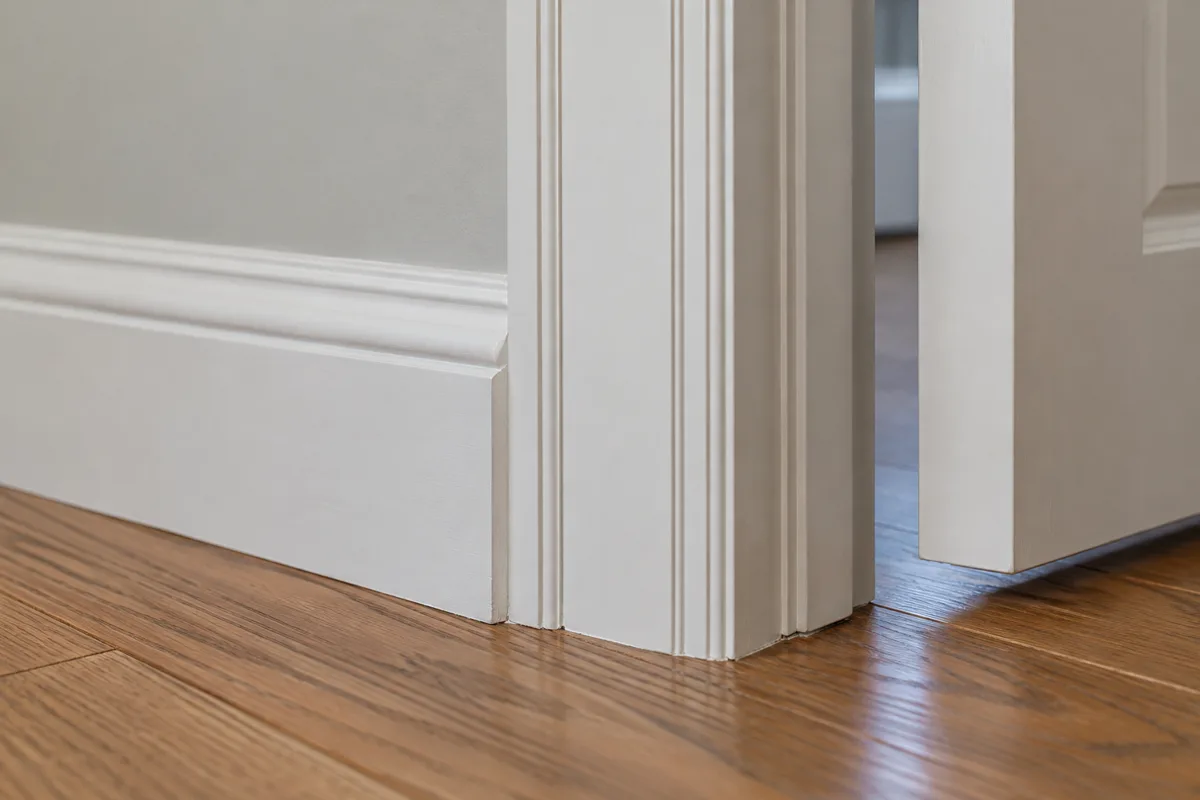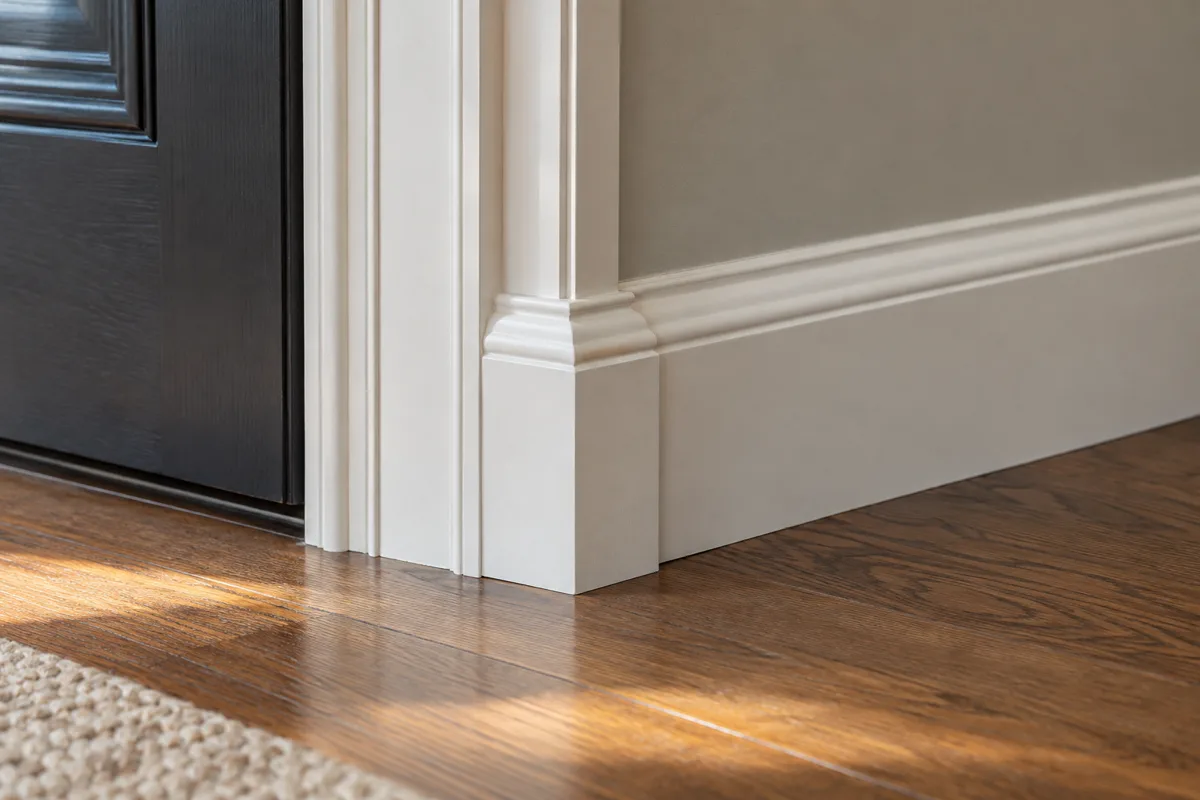
A plinth block sits at the bottom of a door casing and gives the baseboard a separate surface to meet. It can be useful when the horizontal and vertical trim differ in depth or shape. It also adds visual weight at the foot of the opening, so it should be chosen as part of the doorway rather than as a last-minute patch.
The key question is whether the block receives both pieces comfortably. Its face should provide a clear endpoint for the baseboard, and its top should support the casing without an awkward overhang. A block that is barely wider than one component but too shallow for the other solves only half the problem.
Test all three parts together
Lay out the casing, block, and complete baseboard assembly at full size. Include any base cap or shoe. The top of the block needs enough presence above the baseboard to read as a deliberate piece, but excessive height can make a modest doorway seem top-heavy at floor level.
Width is equally important. A broad block beneath narrow casing creates shoulders on either side. Those shoulders may suit a traditional surround; in a restrained room, a smaller difference can be preferable. There is no benefit in selecting a large stock block merely because it covers every possible mismatch.
Check the neighboring space. At a door close to a wall, the block may fit while the baseboard has nowhere useful to terminate. At paired openings, two generous blocks can nearly consume the strip of wall between them. These conditions should be visible in the sketch before installation.
Treat the exposed edges as finished edges
An inexpensive square block can be effective when its edges are neatly eased and its finish matches the surrounding trim. Decorative blocks with grooves or raised faces introduce another profile to coordinate. Use them because the detail belongs in the room, not because they are sold beside the casing.
The floor junction deserves attention too. A block placed over a changing floor level may need individual fitting. Do not let its vertical position drift from one side of the opening to the other simply to follow every small irregularity.
A plinth is not essential at every doorway. If the baseboard already meets the casing neatly, adding one may create complexity without improving the connection. Where it does solve a genuine junction, repeat the chosen proportions consistently across the room and keep a labeled sample for later repairs.