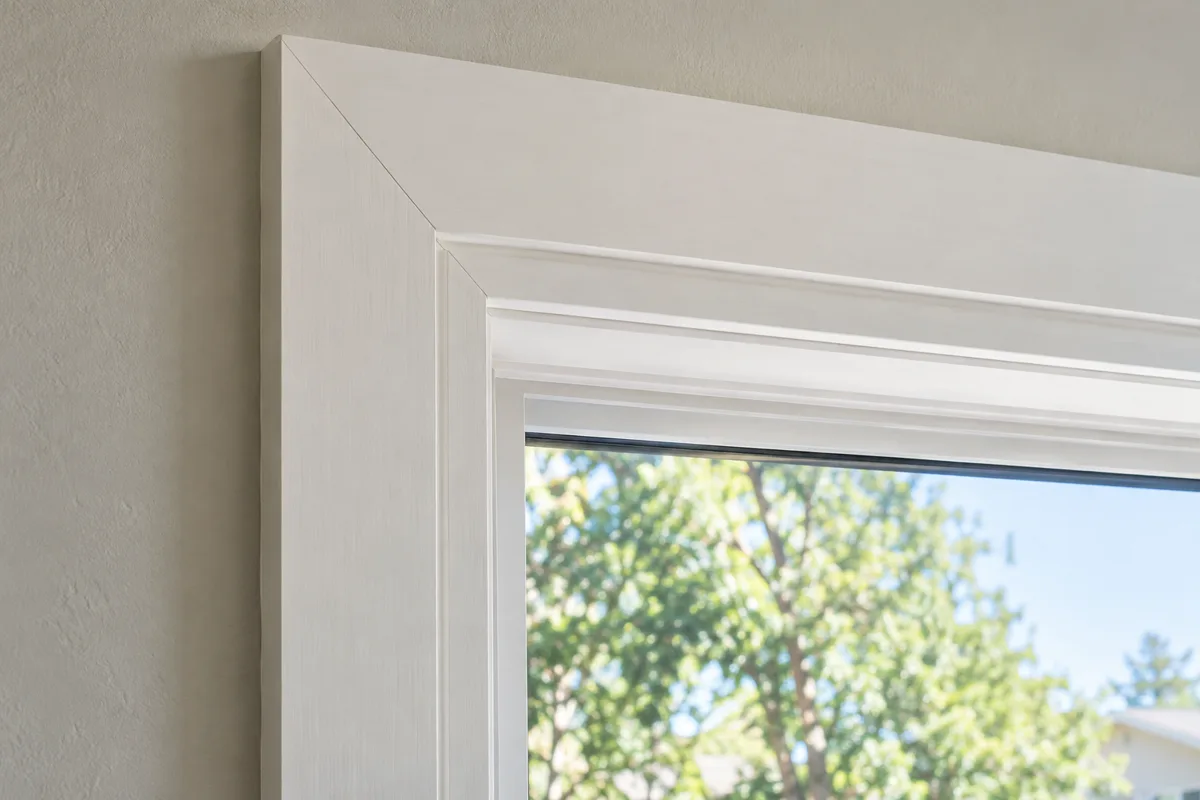
Picture-frame casing surrounds a window on all four sides with a continuous trim outline. It omits the projecting stool-and-apron arrangement found in many traditional interiors. The result can be a compact, orderly frame, especially where furniture, curtains, or a narrow passage make a ledge inconvenient.
The simplicity is visual rather than automatic. All four corners are visible, and the lower horizontal piece must work with the installed window and wall. Start by checking the window manufacturer's interior finishing requirements. A decorative frame should not interfere with operation or cover components that need access.
Decide how strongly to frame the view
A broad casing makes the window a more substantial feature. A narrow one leaves more emphasis on the glass and wall. Compare the proposed width with nearby door casings; matching widths can unify the room, while a controlled difference can acknowledge the different scale of the openings.
A shaped profile carried around four corners creates a stronger border than a flat board of similar width. If the room already has patterned curtains, a busy view, and detailed doors, a quieter frame may be enough.
Tape the outside boundary on the wall before ordering. Pay particular attention to the strip between adjacent windows. Two full casings can leave a narrow sliver of wall that feels less intentional than a combined or otherwise coordinated trim arrangement.
The bottom is not just another side
The lower casing receives a different view and different use from the top. It may sit near a desk, bed, or kitchen work surface. Confirm that its projection does not create a catch point, and that its top edge does not form an awkward dust ledge against the window.
If the existing window has a stool, converting to picture-frame casing may require more than removing the ledge and adding a fourth board. The underlying construction and exposed surfaces need to be assessed. Treat that as a trim redesign, with appropriate attention to old coatings, rather than assuming the parts can be swapped directly.
Finish a full corner sample to see how the profile changes direction. A continuous outline makes slight inconsistencies more noticeable, so the fit and reveal deserve a careful dry-run.
For several windows in one room, record the casing profile, reveal, and corner treatment once. Consistency in these small relationships lets the frames feel related even when the windows themselves are different sizes.