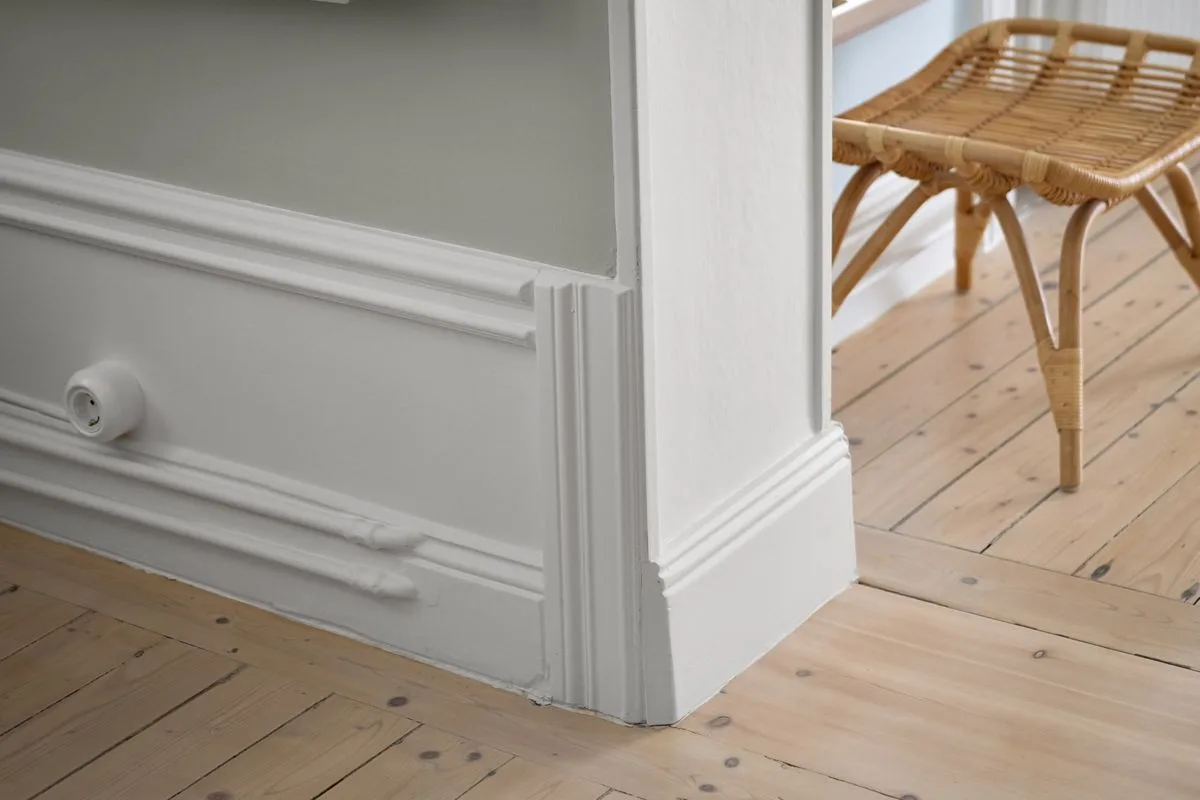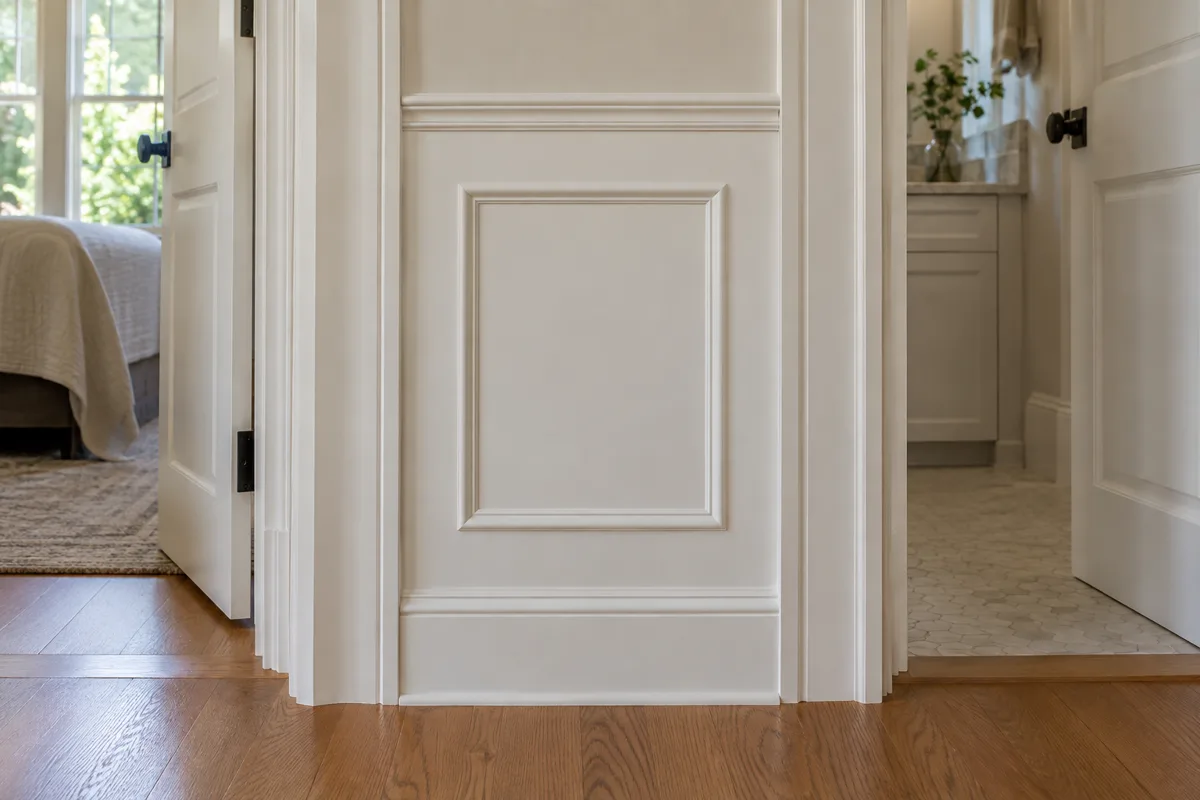
The strip of wall between two doors is often where a trim plan becomes crowded. Each casing looks reasonable around its own opening, but together they leave a sliver of wall—or overlap altogether. Treat the pier as one composition before ordering either surround.
Measure from jamb to jamb at several heights. Add the intended reveals and the actual casing widths. Do not assume the two doors are perfectly parallel or that both frames sit at the same depth. A small variation becomes conspicuous in a narrow gap.
If the proposed casings leave a comfortable visible wall strip, the simplest answer may be to keep them separate. If the remaining strip is extremely thin, compare a narrower profile, a deliberately shared trim detail, or a redesigned treatment for the pair. The choice depends on the surrounding room and the construction.
Avoid an accidental third stripe
A narrow painted wall line between two substantial casings can appear as a dark stripe under side light. Painting it the trim color may soften the contrast, but it does not change the geometry. Test the actual shadows rather than relying on color alone.
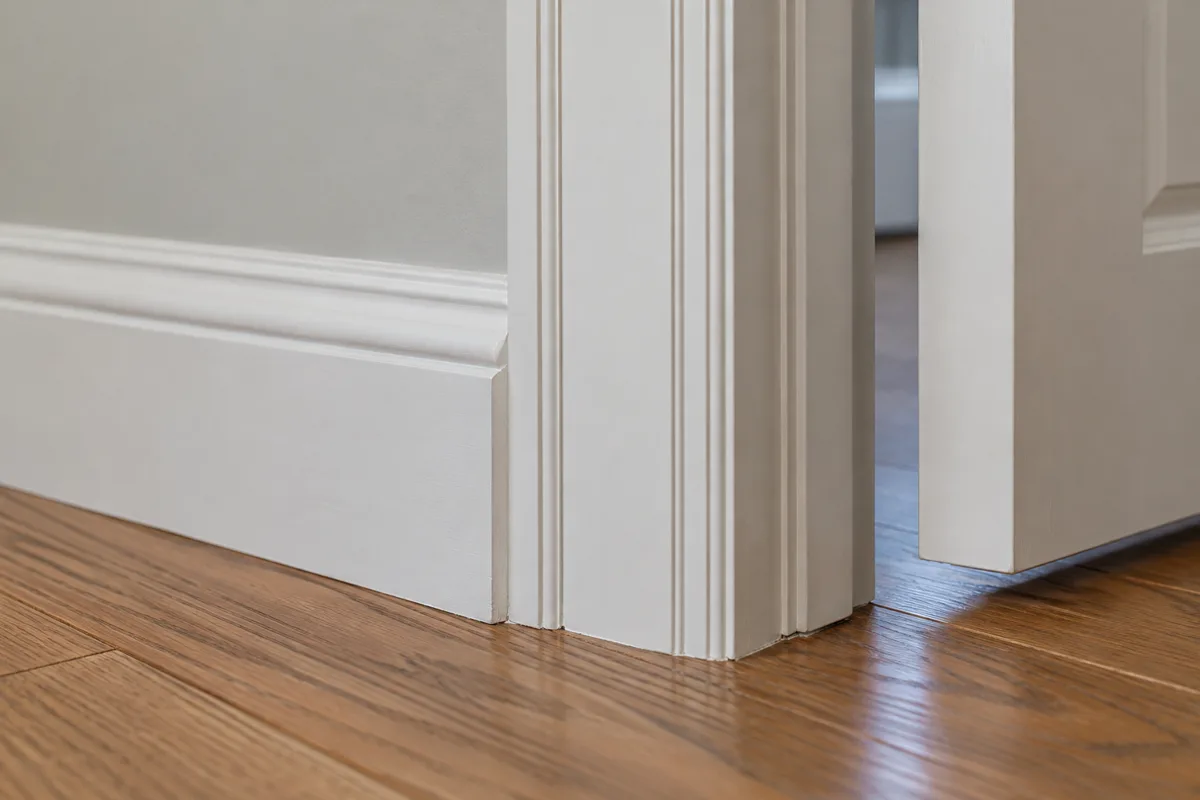
A combined treatment should be designed with the installer, not improvised by pressing two profiles together. Their outer edges may not form a useful joint, particularly when each carries a curved bead. A plain central board can sometimes organize the pair, but its relationship to the heads and base needs to be drawn.
Check the hardware and door swings. Two neighboring doors may interact even before trim is added. Do not introduce projection that reduces clearance or makes a handle strike a new edge.
The top of the pier deserves equal attention. If the doors have different head heights, a continuous horizontal element can create awkward leftover shapes. Separate, restrained casings may acknowledge the difference more honestly.
Make a full-height tape layout and look from both ends of the hallway. The best solution may be less elaborate than the room's main doorway because this is already a visually dense location. Once the pair reads clearly as a group, choose the other trim details to support it rather than adding another layer to conceal the narrowness.