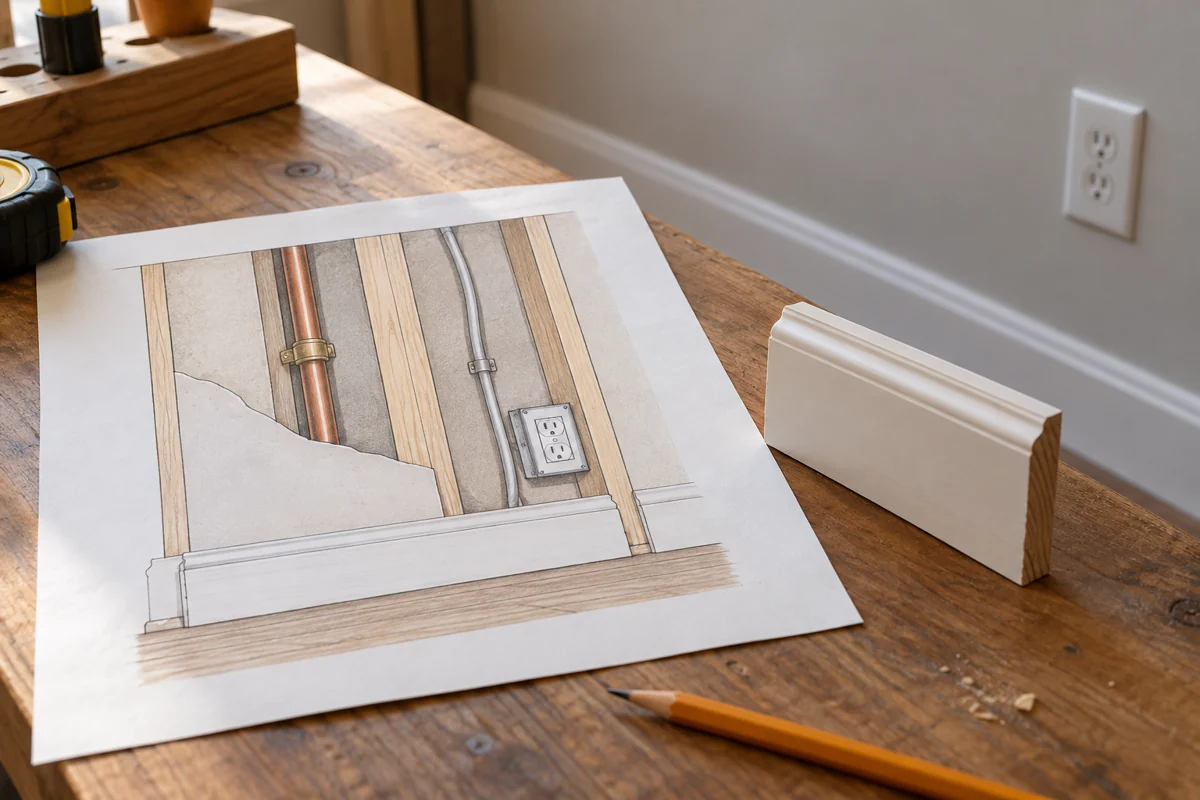
Interior trim is shallow, but its fasteners enter a wall that may contain wiring, plumbing and other services. The small scale of the visible project does not make blind fastening harmless. Before choosing nail length or reaching for a tool, understand the assembly and the locations where it is safe to work.
Existing outlets, switches, radiators and plumbing fixtures provide clues, not a complete route map. Renovations may have changed the original installation. A cable does not have to follow the line someone expects, and a pipe can be close enough to the face to matter.
Gather information without making test holes
Use available drawings, renovation records and appropriate detection methods. Understand the limitations of any detector. A tool that locates a stud does not certify that every point on that stud is clear of services, and a negative reading is not a universal safety guarantee.
Where uncertainty remains, consult a qualified professional who can assess the area and establish an appropriate plan. Do not use a nail, screw or drill bit as a probe. Discovering a concealed service by contacting it is not a measurement technique.
The fastening requirements must also suit the molding and backing. A shorter fastener chosen only to reduce risk may provide inadequate hold; a longer one chosen for strength may reach farther into the wall than expected. These decisions need to be made together, not traded against each other casually.
Avoid false alternatives
Switching to adhesive does not automatically resolve the installation. Some products require mechanical fastening as well, and a bond to weak paint or loose plaster may fail. If the specified method cannot be carried out safely at a proposed location, change the design or obtain a suitable professional solution.
Likewise, turning off one circuit does not establish that the wall is free of electrical hazards, nor does it address plumbing. Electrical isolation and verification belong to the appropriate competent process; they should not become a casual footnote to a decorative project.
Be especially cautious where trim crosses a service area or covers access components. Do not hide shutoffs, inspection points or removable panels behind permanent decorative work. The future person maintaining the house needs access too.
For a hired installation, ask how concealed-service locations will be assessed and how the chosen fasteners suit the wall. A specific explanation is more useful than reassurance that the nails are small.
The sensible outcome may be a revised panel position, a different approved mounting system or professional installation. A finished wall is only successful if its unseen systems remain intact and accessible after the decoration is complete.