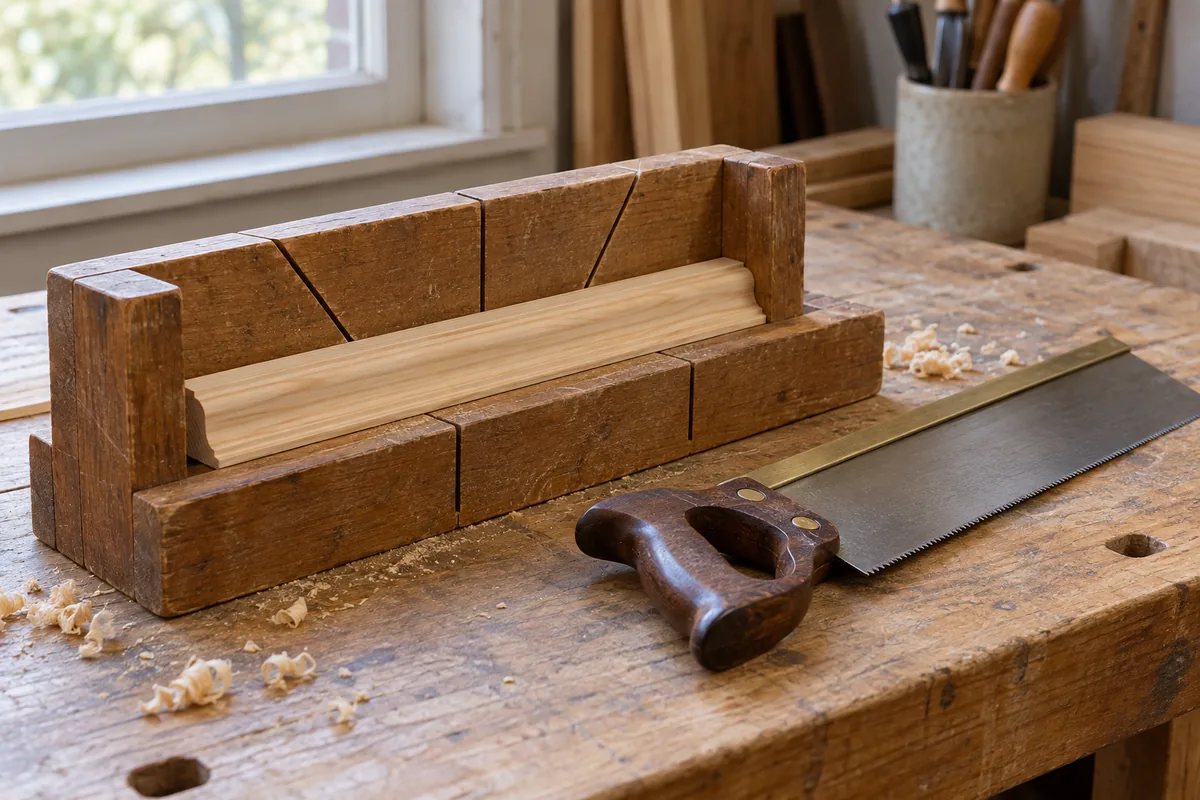
A powered miter saw can make repeated cuts quickly, but speed is not the only consideration in a small trim project. A manual miter box may suit a limited number of cuts in an appropriate profile. Neither choice removes the need for secure support, compatible cutting equipment and safe operating practice.
Begin by counting the work and identifying the material. A few small decorative pieces are different from a full room of tall baseboard. Check the cutting method recommended for the exact product. A tool that handles soft wood comfortably may not be suitable for another material or a larger cross-section.
Consider the complete workspace
The saw itself occupies only part of the space. Long molding needs stable support on both sides as required, room to move it without striking anything, and a safe area for the operator. Dust and noise can make a living room a poor choice even when the tool fits on a table.
A manual setup still needs a secure bench and an appropriate way to hold the work. It is not safe merely because it has no motor. Trying to restrain a tiny piece beside a moving blade or balancing a long board on a chair creates avoidable risks.
For powered equipment, read the manual, use the required guarding and protection, and obtain instruction if the tool is unfamiliar. Do not copy generic hand positions or improvised cutting techniques from a photograph. Rent or borrow only equipment whose condition and operation you can verify.
Accuracy comes before production
A nominal 45-degree setting does not guarantee that two pieces will fit the actual room corner. Measurement, test fitting and orientation remain necessary whichever tool makes the cut. A careful scrap test can reveal a setup or interpretation problem before a full-length board is shortened.
Factor in the finish expected. A stained profile may reveal cutting defects that an opaque finish could hide, though filler should not become a substitute for a sound joint. Ask a millwork supplier whether suitable cutting or preparation services are available when the job exceeds your equipment or experience.
The cheapest option is not necessarily buying the smallest tool, and the best option is not automatically the most powerful one. For a one-room project, paying for competent cutting or installation can be a sensible use of the budget. Choose a process you can carry out safely and consistently, then judge speed within that process.