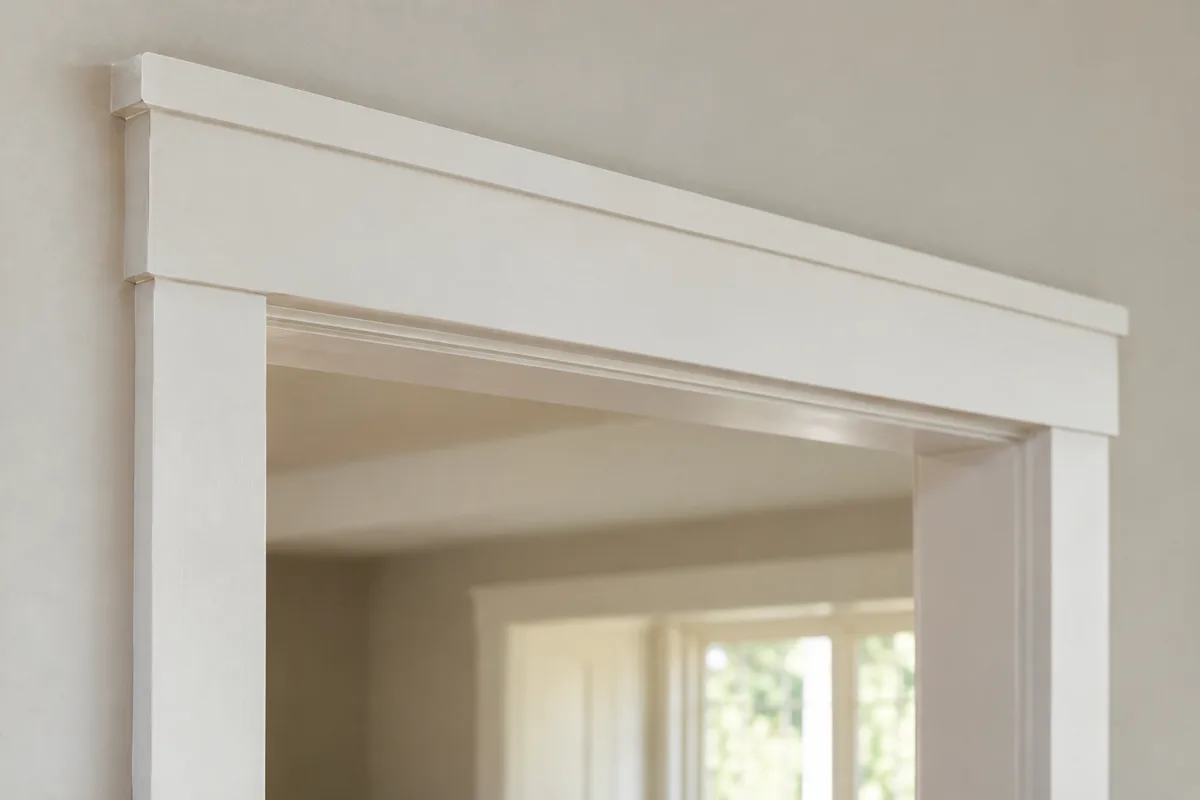
A built-up door head can give an ordinary opening a stronger horizontal line without using an elaborate curved profile. The familiar arrangement combines flat side casings with a wider head board and, sometimes, a small cap. Its success depends less on the number of layers than on how those layers end.
Start by deciding what the head board is meant to do. Should it read as a quiet continuation of the side trim, or as a distinct lintel above the opening? A board that barely extends beyond the side casings has a restrained outline. More overhang makes the head feel like a separate architectural element.
Assemble the end before the middle
The end view reveals the whole stack. Place short offcuts together on a table, including the side casing, head board, any narrow separator, and the cap. Look for a clear progression of surfaces. A thin cap projecting far beyond a shallow head can look like an unrelated shelf.
Do not choose overhangs independently. If the head extends beyond the legs and the cap extends again, the total width grows quickly. Mark the full boundary above the actual doorway. Nearby corners, adjacent doors, and ceiling trim may make the simplest arrangement the better one.
For example, a modest flat head with a small top cap can provide enough emphasis in a low hallway. Adding another projecting strip may change little from the main approach while creating a more complicated return at each end. Removing that layer is a design decision, not an unfinished compromise.
Let the room set the scale
A single oversized header can dominate a room with otherwise light trim. Compare it with the baseboard height and the window casings before committing. The parts need not have identical dimensions, but they should have a believable hierarchy.
The door itself matters too. A strongly paneled door supplies detail within the frame; a plain door may benefit from a little more definition around it. Paint all sample pieces the intended color to see the combined outline rather than a collection of differently colored scraps.
Square joints still demand careful fitting. The head should land deliberately on the side casings, with no unexpected step in depth. If the wall or jamb is uneven, resolve that condition rather than drawing the pieces together until the face twists.
Write down the complete stack, including actual board thickness and the extension at each end. That small elevation sketch makes it possible to repeat the detail at another door without gradually making every header wider or more ornate.