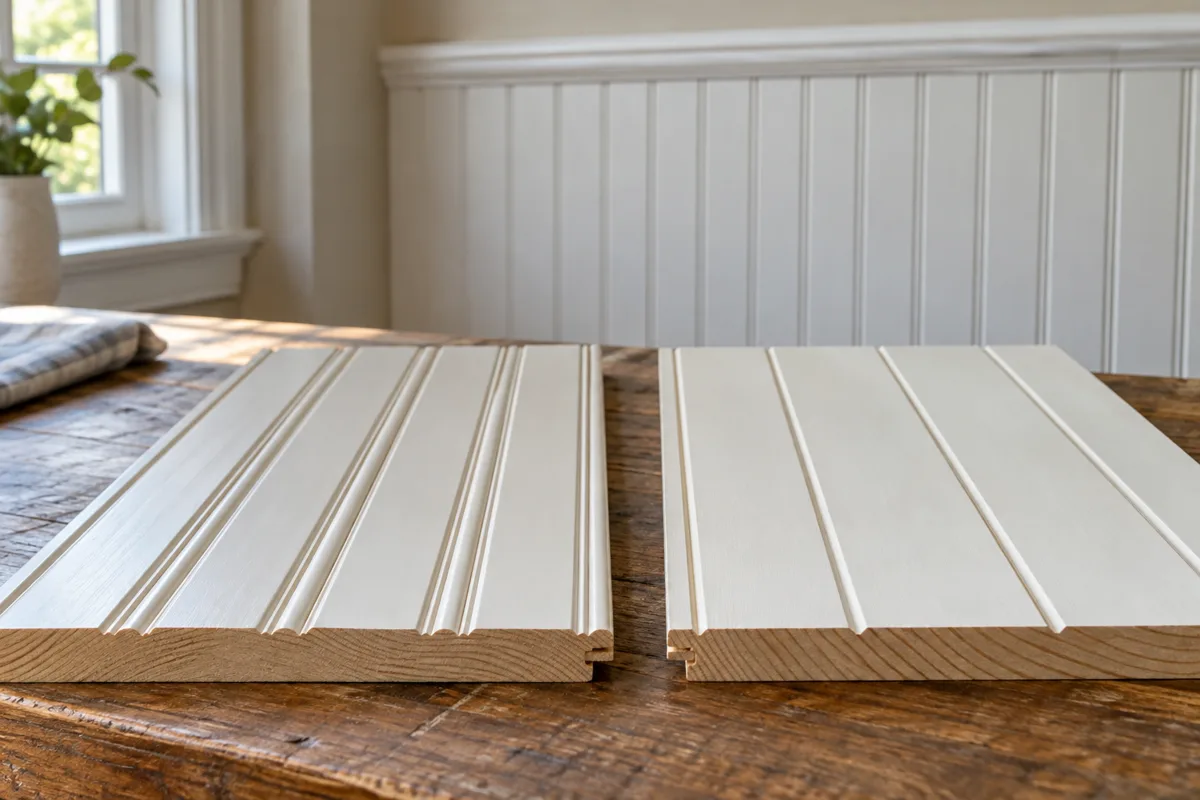
Beadboard creates a narrow raised bead within its repeating pattern. V-groove paneling emphasizes a recessed V-shaped line where the visual boards meet. Both can introduce a vertical rhythm, but their shadows feel different. The distinction is easiest to see on painted samples under light from the side.
Product names do not tell the whole story. Either look may be supplied as individual boards, manufactured planks, or sheets with a repeated pattern. Those formats differ in seams, handling, installation requirements, and the way the edges finish. Compare the actual product construction as well as the visible design.
Look at one wall's worth of repetition
A small sample can make a closely spaced bead look delicate. Repeated across a broad wall, the same detail becomes an active texture. A wider V-groove pattern may feel calmer, although deep grooves can cast strong shadows.
Measure the repeat distance and sketch how many lines would cross the proposed wall. Check the last section at each corner. A very narrow partial board at one end can be distracting even when the rest of the surface is evenly patterned.
Furniture changes what remains visible. Behind a bench, only the upper part may show; beside a narrow doorway, the pattern may be seen as a thin strip. Choose the repeat for those real views, not only for an empty-room photograph.
Compare the finishing work
A sheet product has its own seam and edge details. Individual boards have their own movement and fixing requirements. Follow the chosen manufacturer's instructions rather than transferring a technique from another product with a similar appearance.
The top cap and baseboard should receive the paneling depth cleanly. A fine beaded pattern can look awkward beneath a disproportionately heavy cap, while a broad V-groove surface may support a simpler flat finish.
If the area is exposed to moisture, confirm that the specific material and finish are suitable. A traditional-looking surface is not evidence that it belongs in a wet location.
Make the final comparison in the intended color. Paint can soften shallow texture, while a glossy coating or strong side light can emphasize it. The more useful question is not which style is universally better, but which rhythm you want repeated across the wall you actually have.